
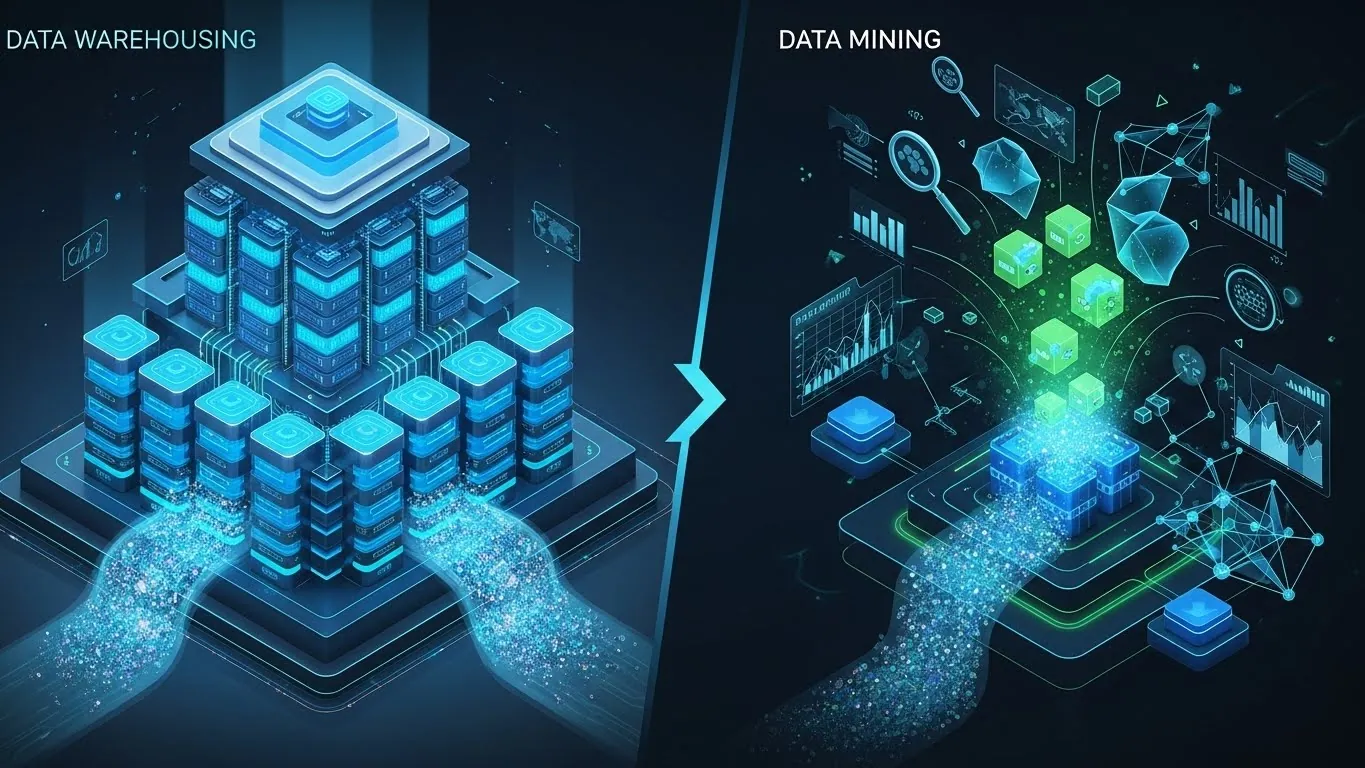
Data-driven organizations often use the terms data warehousing and data mining interchangeably, even though they represent very different concepts. Both play critical roles in analytics, reporting, and business intelligence, but they solve different problems within the data lifecycle. Confusing the two can lead to poor architecture decisions and unrealistic expectations from analytics systems.
Understanding the difference between Data Warehousing and data mining helps organizations design better data strategies, allocate resources effectively, and extract real value from their data investments.
Understanding Data Warehousing in Modern Data Architectures
A data warehouse is a centralized system designed to store large volumes of structured, historical data collected from multiple sources. Its primary purpose is to support reporting, analytics, and decision-making without impacting operational systems. Data warehouses are optimized for read-heavy workloads and complex queries.
In modern environments, organizations pull data from applications, databases, and external platforms. Without a data warehouse, this data remains fragmented and difficult to analyze consistently.
By implementing a data warehouse, organizations create a single source of truth that supports reliable, scalable data analysis across teams and departments.
Understanding Data Mining and Its Analytical Purpose
Data mining focuses on discovering patterns, relationships, and insights hidden within large datasets. Instead of storing data, it analyzes existing data to uncover trends, anomalies, correlations, and predictive signals. Data mining often uses statistical methods, machine learning, and algorithms to generate insights.
Data mining is commonly used for:
- Identifying customer behavior patterns
- Detecting fraud or anomalies
- Predicting future trends
- Segmenting data for targeted analysis
These techniques turn stored data into actionable knowledge. Data mining does not replace storage systems but relies on them to function effectively.
Differences Between Data Warehousing and Data Mining
Although closely related, data warehousing and data mining serve different roles in the analytics ecosystem. Understanding these differences helps organizations design balanced and efficient data platforms.
Purpose and Function
Data warehousing focuses on storing and organizing data. Data mining focuses on analyzing data to discover insights. A data warehouse prepares data for analysis, while data mining extracts value from that prepared data.
Data Type and Scope
Data warehouses store structured and historical data from multiple sources. Data mining works on curated datasets. Mining relies on clean, consistent data, which is why data warehouses often act as its foundation.
Tools and Technologies
Data warehousing uses databases, ETL processes, and storage platforms. Data mining uses analytical models and algorithms. Both technologies complement each other but require different tools and skill sets.
Output and Results
The output of data warehousing is accessible, reliable data. The output of data mining is insights, predictions, and patterns. Together, they support informed decision-making.
How Data Warehousing and Data Mining Work Together
Data warehousing and data mining are most powerful when used together. A data warehouse provides the structured environment needed for accurate and scalable analysis. Data mining then applies advanced techniques to uncover insights within that environment.
Organizations that separate storage from analysis gain flexibility and performance. Data mining models perform better when trained on consistent historical data from a data warehouse.
Platforms like DataMaticsLab help organizations integrate data warehouse architectures with advanced data mining capabilities to support analytics at scale.
Business Use Cases for Data Warehousing and Data Mining
Both technologies support distinct but complementary business use cases. Understanding when to use each helps organizations maximize return on investment.
Common data warehousing use cases include:
- Centralized reporting and dashboards
- Historical trend analysis
- Regulatory and compliance reporting
- Enterprise business intelligence
Data mining use cases focus on deeper insights. Examples include:
- Customer segmentation and personalization
- Fraud detection and risk analysis
- Predictive forecasting
- Optimization and recommendation systems
When combined, these technologies support both operational reporting and advanced analytics.
Choosing Between Data Warehousing and Data Mining
Organizations do not typically choose between data warehousing and data mining. Instead, they determine how to use both effectively within their data strategy. Data warehousing usually comes first, providing a stable foundation for analytics.
Once data is centralized and clean, data mining techniques can be applied to extract insights. Skipping data warehousing often leads to unreliable mining results due to inconsistent data. A balanced approach ensures scalability, accuracy, and long-term analytical success.
Frequently Asked Questions About Data Warehousing and Data Mining
What Is the Main Difference Between Data Warehousing and Data Mining?
Data warehousing stores and organizes data, while data mining analyzes that data to discover patterns, trends, and insights.
Can Data Mining Work Without a Data Warehouse?
Yes, but results are often unreliable. A data warehouse provides clean, consistent data needed for accurate mining.
Is Data Warehousing Part of Data Mining?
Data warehousing and data mining are separate processes, but data warehousing often supports data mining.
Which Comes First, Data Warehousing or Data Mining?
Data warehousing usually comes first to prepare data. Data mining follows to analyze and extract insights.
Do Small Businesses Need Both Data Warehousing and Data Mining?
Cloud solutions allow small businesses to use both technologies cost-effectively for analytics and growth.